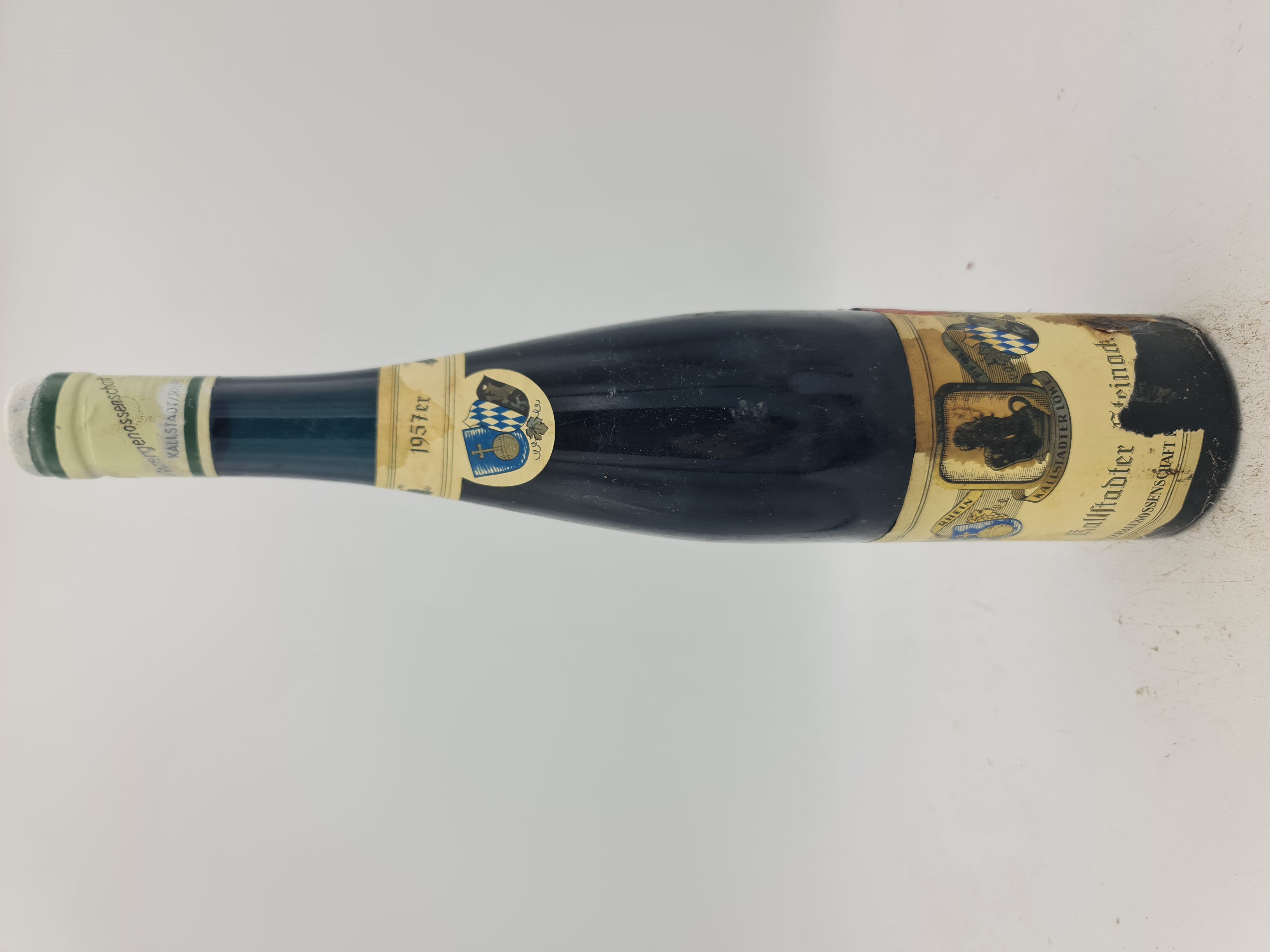


Winzergenossenschaft Kallstadt Weinstrasse - Kallstadter Steinacker Riesling 1957
€125.00*
2 Available immediately


Filling level 6cm, label and capsule damaged and soiled.
Product information
Winzergenossenschaft Kallstadt Weinstrasse - Kallstadter Steinacker Riesling 1957, Palatinate, Germany
Introduction: A yellowed chapter of Palatinate winegrowing history
In the 1950s, the Kallstadt winegrowers' cooperative was a central collection point for the grapes of the many small winegrowers in the village. The Kallstadter Steinackeris a historical field name that is hardly used today - presumably a smaller parcel or vineyard that later merged into the large "Kallstadter Saumagen" vineyard. A Riesling from this specific "Steinacker" from 1957 is therefore more than just a wine: it is a liquid archive piece ofa long-gone parcel structure and an era in which the co-operative ensured sales and shaped viticulture. The 1957 vintage was classic, acidic and known for its longevity - a last hope for a wine that was never intended to be kept for half a century.
Sensory prognosis (with the greatest reservation)
A cooperative wine of this age is an archaeological sample. The following description represents the absolute best-case scenarioof an over-aged bottle. The likelihood of a tired, over-oxidised or faulty wine is very high.
Colour
A pale, translucent golden brown to amber gold with olive green reflections on the rim. The clarity can still be surprising, but the intensity is low.
Nose
The bouquet, if still recognisable, is completely dominated by tertiary and oxidative notes. Primary fruit is no longer present.
Dominant: Petrol, paraffin, beeswax, honeycomb, roasted almonds or walnut.
Dried fruit: A hint of dried apricots, sultanas or prunes.
Oxidative notes: A distinct sherry-like (Madeira) or rancid component - signs of advanced maturity. This can be interesting in moderation, but usually dominates the picture.
Earthy nuances: Damp leaves, old wooden crate.
Risk: The nose can also be flat, dull or characterised by unpleasant cork defects.
Palate
Texture: Light, thin and watery. The body is minimal; the former structure is completely degraded.
Acidity: The decisive life factor. If the acidity of the 1957 vintage is still perceptible, it lends the wine a surprising freshness and length. If it is exhausted, the wine appears flat, lame and unpleasantly sweet.
Flavour: A pale echo of the nose: honey, wax, some dried fruit, nuts.
Finish: Very short to non-existent. A long finish is extremely unlikely with this origin and age.
Historical & oenological classification
Vintage 1957 in the Palatinate
A classic, rather cool and acidic vintage. The wines were often tart and restrained in their youth, but possessed a good structure for medium to long ageing. For a simple co-operative wine, a shelf life of 10-15 years was realistic - 65+ years is a huge excess.
The "Steinacker" site
The vineyard name indicates a stony, barren soil- presumably with limestone or red sandstone components. Such soils often give Rieslings a pronounced minerality and help to retain acidity. The exact parcel is no longer recorded in the official vineyard register.
Winegrowers' cooperative in the 1950s
The co-operative pooled the harvests of many winegrowers. The quality was solid, but rarely spectacular. The cellar technology was traditional (large wooden barrels, no temperature control). A Riesling bottling with vineyard names such as "Steinacker" indicates that the co-operative was quite differentiated at the time - this was not a simple blend, but a selected lot from a parcel considered to be good.
Condition assessment & risk
Critical factors
Age & longevity: The wine is well beyond any realistic limit. Any wine character still perceptible is a miracle.
Fill level: A low fill level (below "mid-shoulder") is very likely and indicates strong oxidation.
Cork: The original co-operative cork is extremely brittle after 65 years and is a major weak point.
Recommendations & conclusion
Handling the bottle
Do not open for consumption. This is an object for the display case, not for the palate.
Keep it as a historical document.The bottle with its original label, fill level and cork is a rare testimony to the history of the Palatinate co-operative and the old field names.
If opened nevertheless: Leave to rest for a long time, decant with the utmost care (sediment separation only), taste at 10-12°C - but with zero expectation.
Final thought
The Kallstadter Steinacker Riesling 1957 is not a wine for connoisseurs, but a wine-historical relic. It tells of a time when winegrowers' co-operatives formed the backbone of German viticulture, when field names such as "Steinacker" were still alive and when a simple Riesling - even if not made for eternity - could still last for over half a century, at least as a bottle. Its value lies not in its flavour, but in its authenticity as a forgotten piece of local history. A collector's item for the museum, not for the wine cellar.

|
Alcohol: | 10 |
|---|---|---|

|
Colour: | white |

|
Country: | Germany |

|
Filling quantity: | 750 ml |

|
Flavour: | sweet |

|
Grape variety: | Riesling |

|
Product type: | Wine |

|
Region: | Palatinate |

|
Type of wine: | White wine |

|
Vintage: | 1957 |

|
Producer: | Kallstadt Winegrowers' Co-operative |
Log in
Allergens: Sulphites
Bottler: Producer