Over 50,000 bottles in stock Worldwide shipping Express delivery possible !

Product information

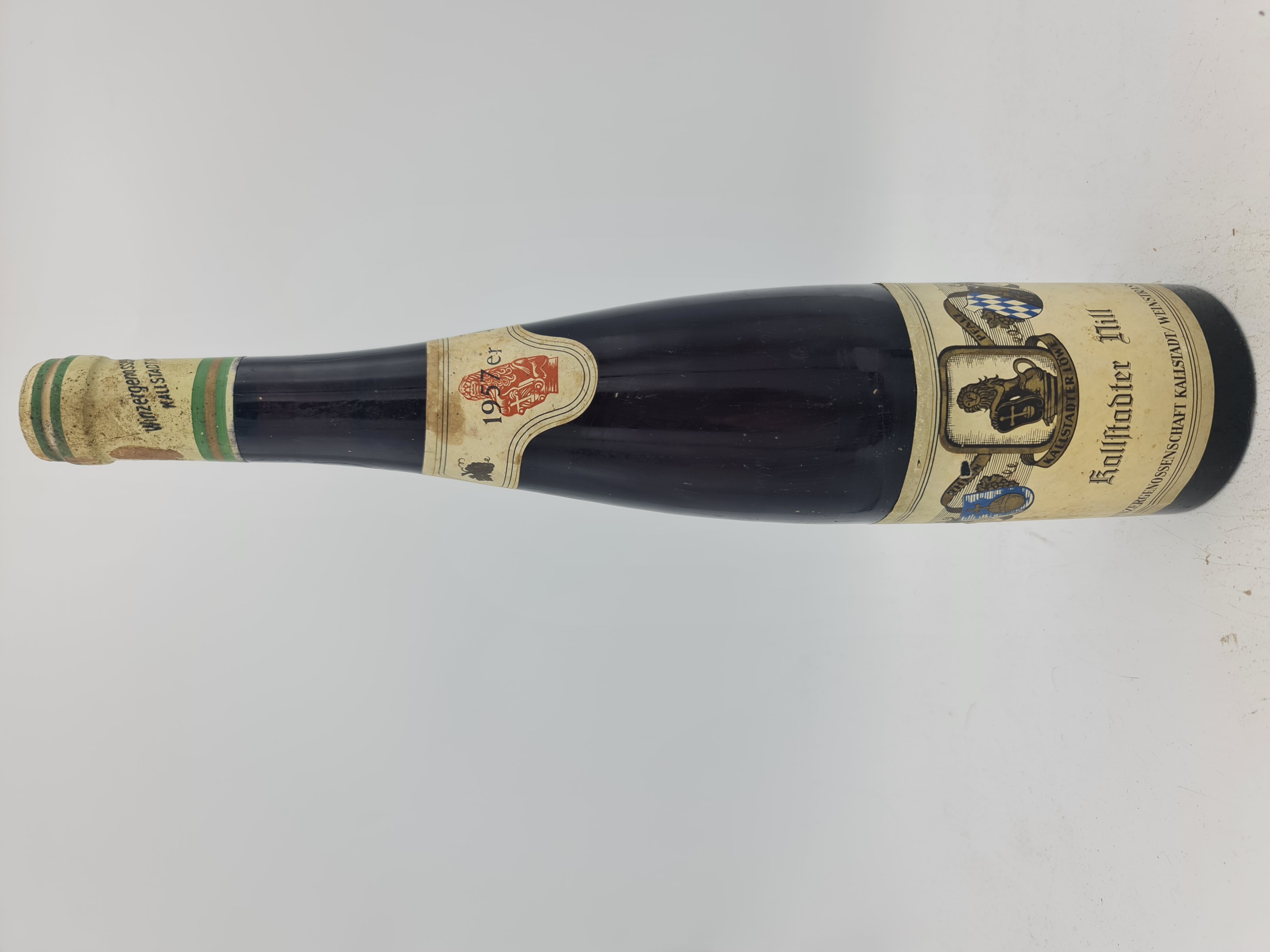
Winzergenossenschaft Kallstadt Weinstrasse - Kallstadter Nill Riesling 1957, Palatinate, Germany

Introduction: A piece of forgotten terroir history

This bottle is a doubly historic document: it comes from the rare, classic 1957vintage and bears the name of a single vineyard that is rarely used today - Kallstadter Nill. In contrast to the better-known large vineyard "Saumagen", "Nill" refers to a specific, presumably smaller parcel in Kallstadt. A wine like this from a winegrowers' cooperativeis a rare, unadulterated look at the terroir-specific wine culture of the Palatinate in the 1950s, before land consolidation and the large vineyard system caused many of these small-scale names to disappear. It is the bottle of a local patriot or an archivist.


Sensory forecast (with reservations)

All forecasts for a co-operative wine of this age should be treated with extreme caution. The ageing conditions of the last 65+ years are the decisive factor.

Colour

  • Expect a pale to medium golden yellow colour with strong amber to tea-brown reflections. A clear, light colour would be a small sensation and would indicate excellent acidity and storage.

Nose

The bouquet, if still intact, will be completely in the tertiary spectrum.

  • Dominant: Pronounced petrol and mature notes (beeswax, honeycomb, candle), mixed with aromas of dried apples, apricot jam and a distinct nutty (walnut, hazelnut) or even slightly sherry-like oxidation note (rancio).

  • Search for traces of "Nill": If the terroir shines through, an earthy-spicy or a specifically stony minerality could become apparent. The name "Nill" (perhaps from "Neuland" or a field name) gives hardly any clues here.

  • Risk: The nose could also be dominated by faults: heavily madeirised (like old sherry), tired and flat (lack of acidity) or with cork or Brettanomyces faults (animalistic, stalky).

Palate

  • Texture: Probably light to very thin, with a frayed, soft structure. The original fruit and acidity are almost completely gone.

  • Acidity: The absolute key criterion. If it is still noticeable and invigorating, the wine may have retained a certain racy flavour and length. If it is exhausted, the wine will appear short, flat and tired.

  • Flavour: A pale reminder of the nose: honey, wax, dried fruit and nuts.

  • Finish: Very short to non-existent. A long finish is extremely unlikely for a wine of this origin and age.


Historical & onomastic classification

About the "Kallstadter Nill" site

  • "Nill" is a historical vineyard name that is no longer listed as an individual vineyard in official German wine law. It was presumably absorbed by the large "Kallstadter Saumagen" vineyard or is an old field name. Its use on the label shows that the cooperative was still characterised by its small-scale origin at the time - a detail that has been lost today.

  • The terroir-specific character of this micro-parcel can only be reconstructed from this bottle.

Winegrowers' co-operative in the 1950s

  • See previous report: Focus on solidity and suitability for the masses. A 1957 "Nill" was probably a slightly better, site-specific cask proof within the co-operative range.

Vintage 1957

  • An acidic, classic vintage (see previous reports). This is the greatest hope for the eventual viability of this wine.


Condition assessment & risk

Critical evaluation criteria

  1. Shelf life limit: This wine is well beyond any intended shelf life limit. Any recognisable wine character is a gift.

  2. Fill level & cork: Very likely low. The simple co-operative cork is a massive weak point.

  3. Sensory risk: >90% for fatigue, oxidation (Madeirisation) or faults.

Recommendation when opening

  • Only open out of historical curiosity.

  • Handlewith care (leave to stand, decant).

  • Taste immediately after opening, do not expect any development in the glass.

  • Temperature: 10-12°C.


Conclusion & recommendation for the owner

The Kallstadter Nill Riesling 1957 is an archaeological find. Its value lies not in its sensory enjoyment, but in its existence as a rare, terroir-specific contemporary document of a defunct co-operative winery practice.

  • Recommendation 1 (preference): Keep unopened. it is more interesting as a complete, sealed historical object. It can stand as a curiosity in a collection that shows the depth of Palatinate wine history.

  • Recommendation 2 (only if you have a strong urge to research): Open cautiously. Be prepared for disappointment. Record the sensory findings as a contribution to oral wine history.

Final judgement:This bottle is a silent, yellowed contemporary witness. It is the opposite extreme to the great growths of famous estates - modest, everyday and therefore perhaps even more fascinating for the historian in its preserved form. A wine that shouldnot be drunk, but studied.

Alcohol Alcohol: 10
Colour Colour: white
Country Country: Germany
Filling quantity Filling quantity: 750 ml
Flavour Flavour: sweet
Grape variety Grape variety: Riesling
Product type Product type: Wine
Region Region: Palatinate
Type of wine Type of wine: White wine
Vintage Vintage: 1957
Producer Producer: Kallstadt Winegrowers' Co-operative

0 of 0 ratings

Average rating of 0 from 5 stars

Rate this product!

Share your experiences with other customers.


Allergens: Sulphites

Bottler: Producer