
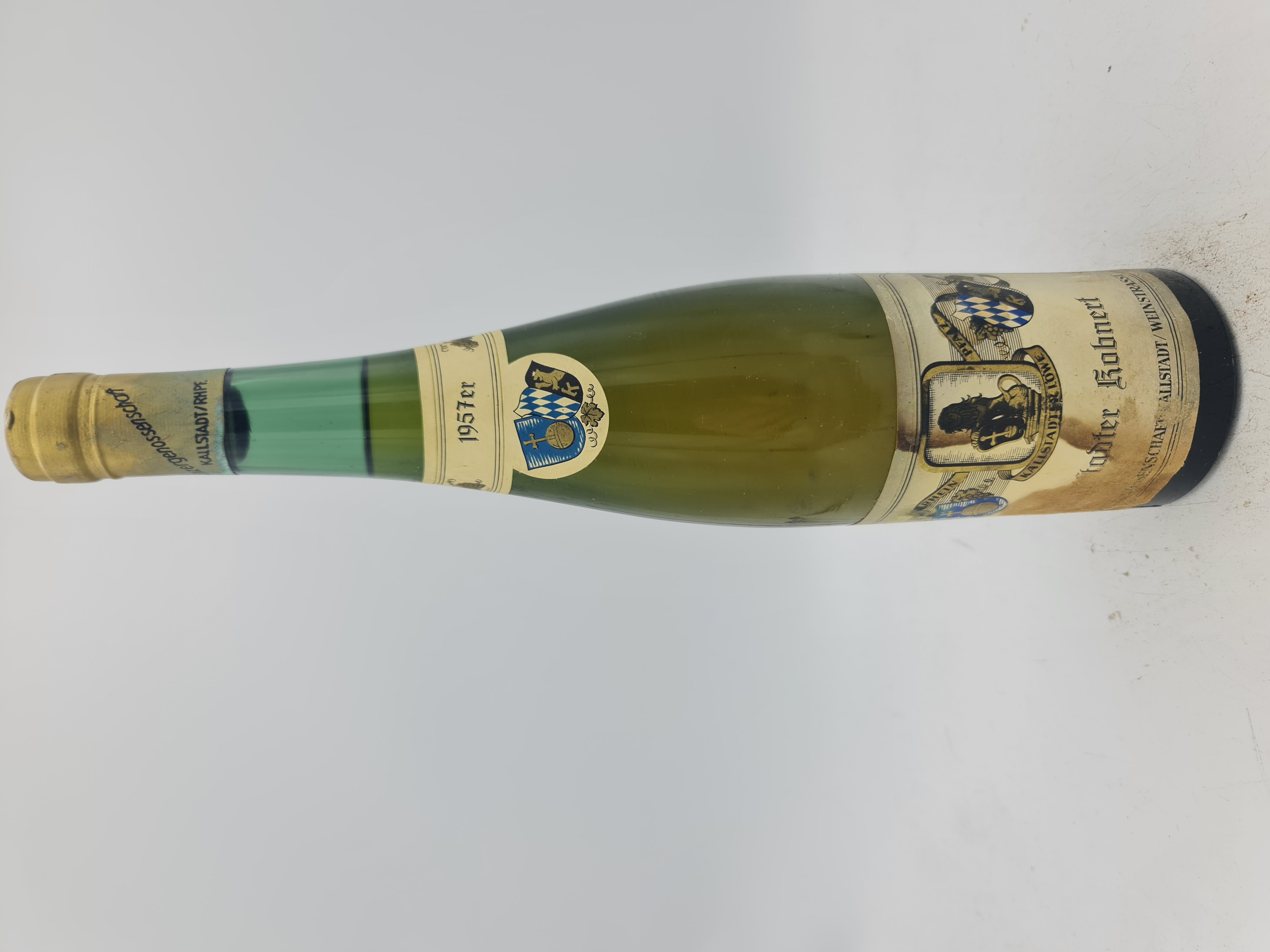


Winzergenossenschaft Kallstadt Weinstrasse - Kallstadter Knobert Riesling 1957
€145.00*
1 Available immediately


Fill level 3-4cm, label soiled and capsule good.
Product information
Winzergenossenschaft Kallstadt Weinstrasse - Kallstadter Knobert Riesling 1957, Palatinate, Germany
Introduction: A forgotten terroir fossil
This bottle is a rare and fascinating piece of Palatinate micro-history. The "Kallstadter Knobert"is a historical vineyard name that is no longer in use today , which presumably referred to a specific, smaller parcel in Kallstadt and disappeared in the course of land consolidation and the introduction of the large vineyard system. Such a wine from a winegrowers' cooperative from the classic, high-acid 1957 vintage is therefore doubly significant: it is not only a testimony to a bygone era of viticulture, but also to a lost, small-scale terroir differentiation. More than a beverage, it is an archival find.
Sensory prognosis (with the strictest reservations)
For a simple co-operative wine of this extreme age (67+ years), the expectations lie in the realm of the historical, not the sensory-reliable. The forecast describes the absolute best-case scenario of a perfectly stored bottle.
Colour
Most likely a pale to medium golden brown or amber gold colour with olive green reflections on the rim. A clear, light colour would be a minor miracle.
Nose
If the wine is still alive, its bouquet is completely dominatedby tertiary and oxidised notes.
Dominant: Intense aromas of petrol, paraffin, beeswax, honeycomb and roasted nuts (walnut, hazelnut).
Dried & matured fruit: Fading notes of dried apples, apricot jam, sultanas.
Oxidation & maturity: A clear sherry-like (Madeira) or rancio note - a sign of progressive, noble oxidation. Notes of damp leaves, cedar and tea.
Risk: A tired, flat or unpleasantly madeirised aroma is very likely to dominate . Primary fruit no longer exists.
Palate
Texture: Expect a very light, thin, possibly frayed texture. The body is minimal.
Acidity: The only possible lifesaver. The 1957 vintage had good acidity. If it is still perceptible and invigorating, the wine may have retained a certain structure. If it is exhausted, the wine is flat, tired and short.
Flavour: A pale reflection of the nose: honey, wax, nut and a sherry-like spiciness.
Finish: Very short to non-existent. A long finish is almost impossible for a wine of this provenance and age.
Historical & onomastic classification
About the "Kallstadter Knobert" site
"Knobert" is an extinct vineyard name; its exact location, soil composition and typical characteristics are hardly known today and can only be reconstructed from such bottles. Its use on the label is a precious reference to the historical diversity and small-scale nature of Palatinate vineyards before standardisation.
Winegrowers' co-operative in the 1950s
The co-operative was the central marketing pool for many small winegrowers. A wine with a specific vineyard name such as "Knobert" indicates that the co-operative was still separately labellingbarrel bottlings from certain plots that were considered better - a procedure that is unusual today.
Vintage 1957
A classic, acidic and long-lived vintage. This is the best hope for the possible survival of the wine. Even simple wines from this year could age surprisingly well if stored well.
Condition assessment & risk
Critical evaluation criteria
Over-ageing: The wine is well beyond any realistic shelf life limit. Any sensory perception beyond flaws is a gift.
Fill level & cork: Very likely low. The single co-operative cork poses the greatest risk of leakage.
Sensory risk: >95% for overoxidation (strongly sherried), fatigue or malformation.
Recommendation for opening
Only open for academic and historical purposes.
Handlewith extreme care (leave to stand for a long time, decant carefully).
Taste immediately after opening, do not expect any development.
Temperature: 10-12°C.
Conclusion & recommendation for the owner
The Kallstadter Knobert Riesling 1957 is archaeological wine excavation material. Its value lies solely in its rarity as an almost forgotten, terroir-specific contemporary document of a vanished co-operative practice.
Recommendation 1 (urgent): Preserve unopened as a museum object.As an intact, sealed historical artefact, it is invaluable to collectors and local history museums. It tells a story that no current bottle can tell.
Recommendation 2 (for scientific documentation only): Open carefully and record.Be aware of the almost certain sensory failure. Document the findings for regional wine history.
Final judgement:This bottle is a silent ambassador of a bygone world. It is the opposite of a spectacular top wine - modest, commonplace and, precisely because of this, an untouched object of great historical significance. It should not bedrunk, but preserved and studied. A find for the archive, not for the palate.

|
Alcohol: | 10 |
|---|---|---|

|
Colour: | white |

|
Country: | Germany |

|
Filling quantity: | 750 ml |

|
Flavour: | sweet |

|
Grape variety: | Riesling |

|
Product type: | Wine |

|
Region: | Palatinate |

|
Type of wine: | White wine |

|
Vintage: | 1957 |

|
Producer: | Kallstadt Winegrowers' Co-operative |
Log in
Allergens: Sulphites
Bottler: Producer