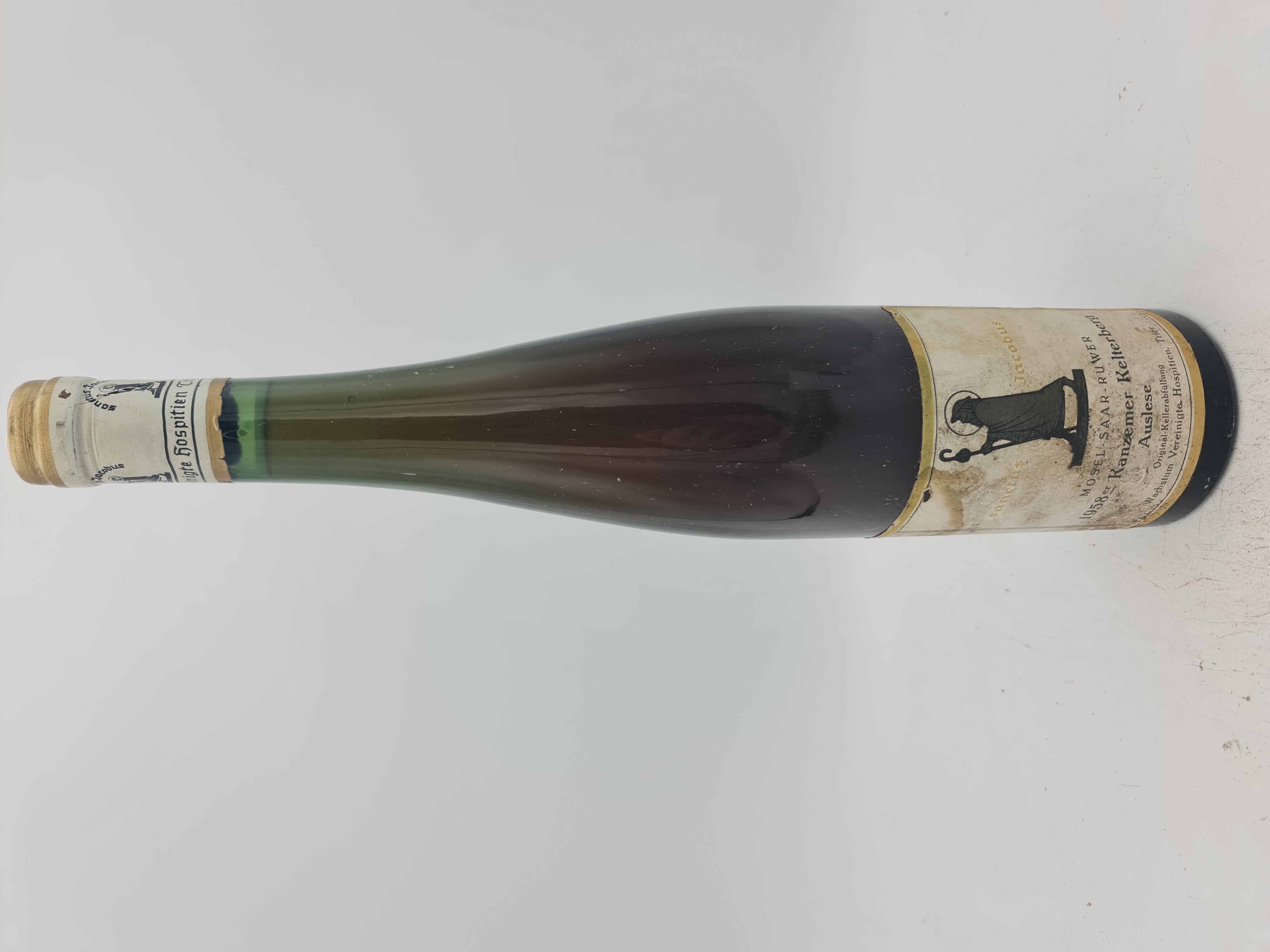


Vereinigte Hospitien 'Sanctus Jacobus' Trier - Kanzemer Kelterberg Riesling Auslese 1958
€195.00*
1 Available immediately


Filling level into neck, capsule good and label good.
Product information
Vereinigte Hospitien 'Sanctus Jacobus' Trier - Kanzemer Keltenberg Riesling Auslese 1958
I. The winery: United Hospices Trier
The Vereinigte Hospitien (United Hospices) in Trier is one of the most traditional wineries in the German Moselle wine-growing region. The foundation winery is located in the heart of Trier, the oldest German city, which was once an imperial Roman residence. Its origins date back to Roman times; the wine cellar is considered to be the oldest of its kind in Germany.
The roots of viticulture are deeply interwoven with medieval pilgrimage. The figure of St James (Sanctus Jacobus) with a walking stick depicted on the label is a direct reference to St James' Hospital in Trier, which provided a hostel for pilgrims on their way to Santiago de Compostela. This connection gives the Sanctus-Jacobus wines their name.
The winery has been run as a charitable foundation under public law since 1805 and the funds generated from its assets are channelled into social institutions that provide a home for the elderly, sick and people in need of care. Today, the winery cultivates around 25 hectares of vineyards, 90 per cent of which are planted with Riesling. It owns monopole vineyards in top locations on the Moselle and Saar and is a founding member of the VDP (Association of German Prädikat Wine Estates).
The cultivation of Riesling was first recorded in 1464 in the account book of St Jacob's Hospital, which underlines the claim to be one of the oldest Riesling vineyards in the world.
II The vineyard: Kanzemer Keltenberg
The Kanzemer Keltenberg is not to be confused with the more prominent, monopole vineyard Kanzemer Altenberg. Both are located in the district of Kanzem, which lies directly on the Saar between Konz and Saarburg. The site belongs to the Saar area of the Moselle wine-growing region and is known for its steep, south-facing slopes.
The soils are dominated by the region'sclassic Devonian slate.This slate stores the warmth of the sun and transfers it to the vines, which favours grape ripening. At the same time, the slate provides the characteristic, fine mineral vein and lively acidity of Saar Rieslings. The steep slopes (inclination often between 50 and 85 per cent) require extensive manual work in the vineyard.
III. 1958 vintage on the Saar
The 1958 vintage is a remarkable vintage in German wine history. It was characterisedby a very late but ideal autumn.A long, warm and dry autumn allowed the grapes to develop a high degree of physiological ripeness and natural sugar. These conditions favoured the development of noble rot and the production of Auslese wines of exceptional concentration and depth. Today, the wines of the 1958 vintage are renowned for their complex flavours, remarkable longevity and elegant, balanced character.
IV. The predicate: Riesling Auslese
The designation Auslese is a quality level in the German Prädikat wine system. It stands for a wine made from selectively harvested, overripe grapes. In the vineyard, only the particularly ripe berries, often affected by noble rot (Botrytis cinerea), are picked by hand. This results in a wine with natural residual sweetness and a complex flavour. The interplay of noble sweet concentration, fine, supportive acidity and mineral elegance is the hallmark of a great Saar Auslese.
V. Current status and available information
There are no concrete digital records, tasting notes or public sales offers for the Vereinigte Hospitien 'Sanctus Jacobus' Trier - Kanzemer Keltenberg Riesling Auslese 1958. The rarity and age of this bottle make a public digital appearance very unlikely. Vintage wines in this class are mostly found in private collections or are traded via specialised auction houses without being made available on the public internet.
However, there is information about comparable Sanctus Jacobus wines of a similar age. For example, a 1959 Vereinigte Hospitien Trier Sanctus Jacobus Scharzhofberger feinste Auslesewas traded at wine auctions. Descriptions of older Sanctus-Jacobus Auslese wines, such as a 1976 Scharzhofberger Riesling Auslese, emphasise the "rich, honey-sweet concentration", which nevertheless retains the "classic acidity of the Saar". These notes give an impression of the typical profile of a mature Sanctus-Jacobus Riesling.
It should be emphasised that the vineyard shouldnot be called "Keltenberg", but correctly "Kanzemer Keltenberg". The online results relating to other winegrowers and vintages from this site provide an indication of the aromatic style. For a similar wine from another producer in the same town and from a similar vineyard, aromas such as "ripe apricot, earl grey, orange blossom" and on the palate "orange marmalade, mocha and a hint of tonka bean" are described.
VI Conclusion and drinking recommendation
The Vereinigte Hospitien 'Sanctus Jacobus' Trier - Kanzemer Keltenberg Riesling Auslese 1958is an exceptional wine that is almost 70 years old. It represents the rich history of the Vereinigte Hospitien, the unique minerality of the Kanzemer slate terraces and the favour of the 1958 vintage. An intense golden to amber colour is to be expected from such a wine. The bouquet would reveal a complex juxtaposition of dried fruit (apricot, peach), honeyed and spicy noble rot notes, petrol-like Riesling typicity and a fine, mineral note.
Due to its age, the bottle will most likely be at or near the end of its drinking window today. The wine should therefore be savoured as soon as possible to experience the remaining bouquet and balance.
The bottle would be perfect for a special occasion, such as an anniversary from the same year. A soft, supple character has developed as a result of the long ageing period; the initial residual sweetness is now harmoniously interwoven with the lively acidity.
Serving temperature: For a wine this old, we recommend a temperature of around 12-14 °C(not too cool). It is advisable to open the bottle a few hours before serving and to decant carefully to separate the natural sediment.
Food recommendation:As a digestif, the wine harmonises wonderfully with slightly bitter desserts (e.g. orange zabaglione), blue cheese, foie gras or Asian curries with coconut milk, which absorb the sweetness of the wine.

|
Alcohol: | 8 |
|---|---|---|

|
Colour: | white |

|
Country: | Germany |

|
Filling quantity: | 750 ml |

|
Flavour: | sweet |

|
Grape variety: | Riesling |

|
Product type: | Wine |

|
Region: | Moselle Saar Ruwer |

|
Type of wine: | White wine |

|
Vintage: | 1958 |

|
Producer: | United Hospitals |
Log in
Allergens: Sulphites
Bottler: Producer