The port wine is a heavy and relatively sweet alcohol strengthened south wine. "Genuine" ports always obtain her genesis in Portugal and to be more precise from an area enclosed exactly in the North- Portuguese Dourotal.
In the 11th century Heinrich had the first types of vine put of Burgundy. New types of vine were especially laid out for the port production in the so-called "Vinho de Lamego" (Lamego is one city of the 8 km of the southern Douroufer) later in the 13th century. In the year 1678 the word developed „Port “as the first time in the connection of the haven wines, whose fermentation process is stopped with the help of an added nature alcohol. The remainder sugar in the haven wines is still present, lends to the haven wines the usually sweetly note at the palate.
We divide up the types of vine into three categories today. The categories in which the port is added are at the area. This is the region in the western part of the lowest point of Douro, the so-called Baixo Corgo which contains 28% of the complete area, to one around the city of peso da Régua. In addition Cima Corgo comes approximately around the city Pinhão in the circle Alijó, which manufactures a third of the haven wines and to good lastly the Douro Superior area of which of São João Pesqueira to the Spanish border there.
A port is divided up into different type categories. The special attention is thereby on colour, quality and kind of storage. The basic types of the port wine, which are to be referred in the retail trade differentiate one:
White Port = This wine turns from white grapes established of the approximately 3 years rests.
Ruby Port = The word Ruby is from the English and means ruby. The wine shall just the same work. He is produced from red grapes which have a firm ruby/red colouring. The strong color states with the fact that in this port wine little oxidation had found instead of. These ports are stored for two to three years.
Twany Port = This port species is produced like "Ruby Port" from red grapes and is stored also between two to three years . After this storage the wine is decanted in small "Pipen" which a fast oxidation draws after himself. The port gets such a brighter colour. It has to be known therefore at "Twany port" well that the colour {paint} does not surrender this to the storage compulsorily ages and therefore can be decided about the quality.
The following type differences arise in the quality and in the storage:
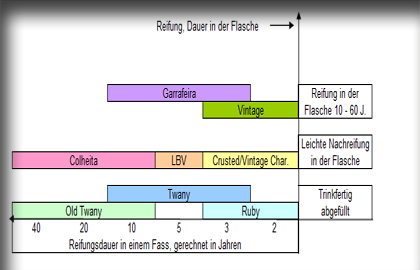
Old/Agent Twany = These ports store 10 to 40 years in a wood barrel .
Colheita = This sort of wine stores at least 7 years in a barrel which is filled different grapes of a volume. To the filling of Colheitas these are ready-to-drinkly and do not increase her quality any more.
Vintage Port = This port belongs to the top class. Only the best volumes are counted as one of the Vintage. In which the declaration is not uniform, every wine-growing estate carries out an exam of its own and decision. A port wine, which reached the Vintage level, filled up in bottles and receives therein its further ripe one. With this maturity every port gets his "depository" which the wine needs to specifically far tyre be able to do. After at least 12 years tyres the Vintage port is drinking ripe.
Late Bottled Vintage Port („LBV“) = This port is similarly an offcut of grapes of a volume like the "Vintage port". The difference consists that "LBV" is stored in a barrel for four to six years. This category is distinguished in addition into the filtered and unfiltered "LBV". The filtered port wine is immediately drinkable, the not filtered is relatively rare and matures in the bottle after.
Vintage Character Port = This port is an offcut from good volumes which, however, do not achieve the quality of the genuine Vintage . To after-mature the wine after three of year old storage not filtered filled up in bottles over then.
Reserve = This concept tempt a port and an elevated quality can be used for every type variant .
Garrafeira = This port wine matures three to six years 8 years at least further in a barrel over after filling in bottles to after-mature. Garrafeira means "bottle maturation" and therefore can be used also for other bottles.
Single Quinta = This can represent each of the ports mentioned before in principle. However, the most frequent ones are Vintage, LBV and Colheita. It is characteristic that the grapes are from one single wine-growing estate (Quinta). This must considerably be made recognizable by the label.
Serving port correctly
One should not decant ports generally which matured in a bottle. Port with barrel storage like Twany, LBV and Colheita etc. can be decanted without problems and is durable even after weeks in the open condition for a long time and can be consumed any time. With very old port wine bottles, which long was stored to often loosen has one the problem the cork without this is crumbs and/or the depot whirled up. Remedy creates special port tongs.
These port tongs are pressed glowing hotly around the neck of a bottle. After that the hot job is cooled down with a cold, wet cloth briefly. By this thermal shock the glass breaks and then can be served.
Enjoying ports depends on the respective type. There are the following differences:
White port is served chilledly for a meal.
Ruby Port wine is rather dessert wines which are served at room temperature.
These traditionally are served Twany ports - as digestion wine. The port heard into a port wine-glass which is very similar to liqueur and sherry glasses.
One should fill the glass up to 80-140 ml (maximum up to half!). The form of the glass is extremely important, she should narrow easily for the aperture (tulip-shaped). Through this the nose can take the flavour better. A trend has gained acceptance in the manufacturer regions, however, by now to use a marc glass for the pleasure. This shall award a special pleasure mark to the ports.